Veltis Intelligence: see your website the way AI does.

Intelligence audits every page of a pharma brand website on the four things AI engines and search need. Can they reach the page, read it, trust it and use it to answer a question? Then it tells your team what to fix first. Brand teams use it as an independent read on the work their agency delivers; in-house teams use it to review their own releases automatically.

Scored checks
44
Scored rules
86
Hard-flag rules
20
AI models compared
10
AI crawlers tested
13
US compliance rules
131

Your agency builds the website. Intelligence tells you how well it works.

Intelligence is a second, independent read on the brand website, for the team that answers for it. It does not replace the people who make the pages.

Brand and marketing teams working with an agency

You brief the agency of record, approve the work and answer for the results. Intelligence shows you, page by page, whether each message survived production intact, where compliance flags sit, how AI engines read the site and how it compares with your competitors. Take the findings into your agency review, and hand the agency page guides it can act on the same day.

In-house content and digital teams

If your marketing is made in house, we set up the rules, checks and peer benchmarks with your team. Every release is reviewed automatically against the same framework, your team sees what to fix before medical, legal and regulatory review, and the baselines improve with every audit. It becomes your own automated quality system.

Medical, legal and regulatory reviewers get flags with the rule and the quoted text, never a verdict. Agencies get anchored page edits and a re-score that shows what moved. See every role we help.

From a brand name to an improvement brief.

You name the brand. Intelligence finds its pages and competitors, scores every page, checks compliance and coverage, compares the results and proposes what to change.

Veltis Intelligence at work. We learn from every site we scan and every correction we review.
  1. Add a brandThe platform finds the brand's website pages and its competitors.
  2. CaptureA crawler and a real browser capture every page. Consent banners are removed before scoring.
  3. ClassifyEach page is filed by type and therapy area, so it is compared with like pages.
  4. ScoreEight criteria run in a fixed order. Code finds evidence, AI labels it, code applies the points.
  5. CheckPages go through the US compliance rulebook and are compared with the approved label.
  6. BenchmarkScores and content coverage are compared with competitor and peer pages.
  7. ProposeFindings become a ranked fix list with drafted page improvements.

Four gates between your page and an AI answer.

AI assistants don't read a page the way a visitor does. They fetch it, strip the layout, split it into passages and quote the passages that answer a question. The four gates follow that path, in order.

  1. Reach

    AI crawlers and search can fetch the page. Robots rules allow them, and they receive the same text a person sees.

  2. Read

    Headings, tables, lists, images and labels carry meaning a machine can parse without the visual layout.

  3. Trust

    Claims keep their context, numbers keep their denominators, and review dates, disclosure and references are present.

  4. Recommend

    The page answers the question its heading promises, at the right reading level for its audience.

Eight criteria. 44 checks. 86 scored rules.

Every rule names its authority: a WCAG accessibility criterion, a validated health-literacy instrument, published evidence or FDA law. Twenty hard-flag rules cap a page's score, whatever else it earns.

  • AI and bot access

    Whether AI search tools can reach the page, whether robots rules separate search access from training access, and whether AI receives the main content a visitor sees.

    Tested across more than ten AI crawlers in two lanes: live answers and training.

  • Page structure

    A clear title, headings in a useful order, tables that explain their rows and columns, meaningful image descriptions, and links and buttons that say where they lead.

    Mapped to WCAG success criteria.

  • Freshness and function

    Visible, unambiguous review dates; working links, files and images; reachable safety information and patient guides; no leftover draft text or missing job codes.

  • Message integrity

    Benefits name their product, numbers say what was measured, percentages keep their denominator, and a passage quoted alone still reads correctly.

  • Audience alignment

    Reading level and understandability for patients or healthcare professionals, scored with published health-literacy instruments.

    SMOG, PEMAT-P, the CDC Clear Communication Index and QUEST.

  • Promise and delivery

    Each heading and button delivers what it promises, footnotes resolve, and instructions are specific enough to act on.

  • Evidence and disclosure

    Medical review, disclosure, an adverse-event reporting route, references, and claims paired with their citations. This is the heaviest criterion, at 20 of 100 points.

  • On-screen experience

    Rendered accessibility, including contrast, target size, reflow and focus; Core Web Vitals; and whether risk and benefit information get comparable visual prominence.

Evidence behind every result.

Every Intelligence finding quotes the text it came from. If a rule cannot reach a verdict from the page, the result is recorded as not measured, never as a pass or a fail.

  • Code finds the evidence, an AI model labels it and code applies the points
  • Every rule names its authority: WCAG accessibility criteria, validated health-literacy instruments such as PEMAT-P and SMOG, or FDA requirements
  • Twenty hard-flag rules cap a page's score, whatever else it earns
  • Every correction we review feeds back into the method
Finding · message integritySample
Page
Dosing and administration
Rule
Percentages keep their population and timeframe
Quoted text
“72% of patients had fewer flare-ups.”
Result
Fails: the figure has no population or timeframe beside it
Proposed fix
“72% of 412 patients had fewer flare-ups over 52 weeks.”
Authority
Published guidance on presenting numbers in health information

Compliance flags and content coverage, ready for MLR.

US promotional rulebook

131 rules in 48 obligations, covering fair balance, brief summary, internet and social promotion, claim types, FTC privacy requirements and accessibility requirements.

FDA label alignment

We fetch the FDA-approved label for the brand and check page claims against it, including omissions and claims the label doesn't support.

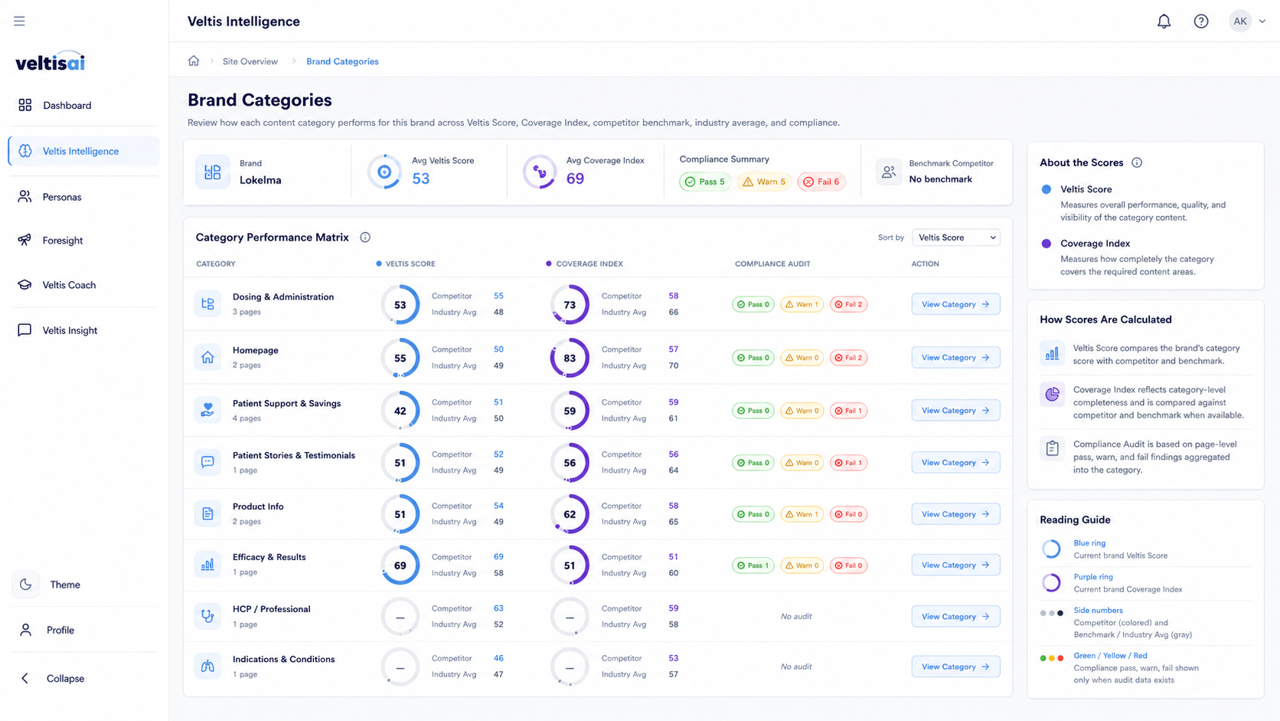
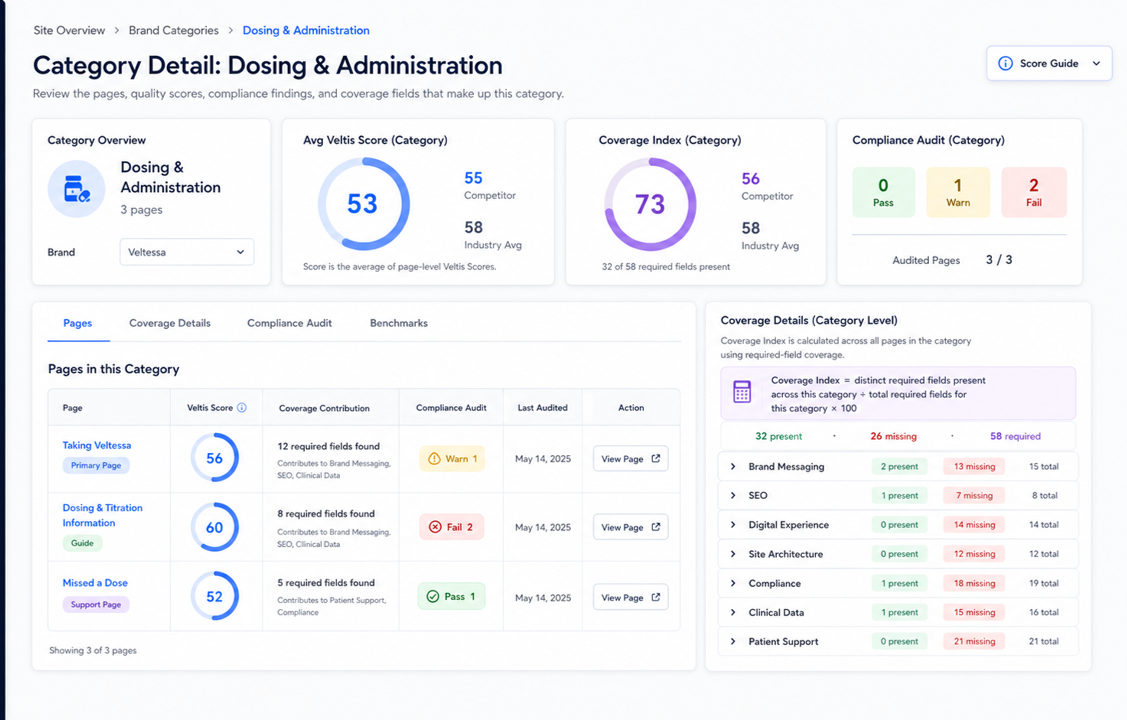
Coverage Index

The share of content fields expected for each page category that your pages carry, compared with peer brands. It sits beside the page score, never inside it.

Flags for your reviewers

Each flag cites the rule and the page text behind it. Your medical, legal and regulatory team makes the decision.

Veltis Intelligence category detail: average page score, Coverage Index against competitor and industry averages, compliance pass, warn and fail counts, and missing content fields by group
Category detail with page scores, Coverage Index and compliance results.

What AI models make of your pages and your brand.

Search is no longer ten blue links. Patients and physicians ask assistants directly. Intelligence measures what those assistants can take from your website, and what they say when asked about your brand.

Ten-model panel

Every page goes through ten leading AI models from several providers. You see where they agree, where they disagree and which pages confuse them.

Crawler lanes

Bots that fetch pages for live answers are reported separately from bots that collect training data, so you can decide what to allow.

AI answer review

We ask AI assistants a set of questions patients and HCPs ask about your condition and brand, then record whether answers mention you, match the label, omit safety warnings or cite your pages.

Share of voice and drift

Track how often your brand appears in AI answers against competitors, and how those answers change over time.

Veltis Intelligence brand categories view comparing page categories and scores
Brand categories view.

Benchmarks that compare like with like.

Competitor discovery

We find your competitors automatically and score their public pages with exactly the same framework.

Page type by page type

Dosing pages against dosing pages, savings against savings, disease education against disease education.

Scored, not sampled

Every competitor page goes through the same 44 checks as yours, so the comparison holds rule by rule.

From findings to a better page.

A score is only useful if it tells you what to do. Intelligence turns findings into work your content team or agency can pick up the same day.

Ranked fix list

Hard flags first, then every finding ordered by the points it recovers and the effort it takes, per page and per category.

Page guides and rewrites

Page-level guides and drafted rewrites delivered as precise, anchored HTML changes, so your agency knows exactly where each edit goes.

Re-score after changes

We run the same checks on the updated page and show what moved, rule by rule.

Designs from what works

We draw on our library of scored pharma pages to propose page structures that perform well for each page type.

We learn from every site we scan and every correction we review. Reviewed corrections feed straight back into the scoring, so each audit is sharper than the last.

What you receive.

In recent runs a page took about a minute to score, and a 100-page site finished in under an hour. Audits are delivered as a Pharma Page Improvement Review.

Start with 90 days. We audit your brand site and your competitors, deliver the improvement brief, then re-score the pages your team changes so you see what moved.

Site overview

Pages by category, audience and page type, with crawl completion, scores, coverage and compliance at a glance.

Four scorecards

Clinical credibility, patient communication, technical readiness and AI portrayal, each shown with how much of it was measured.

Page-level evidence

Every rule result with the text that triggered it and the authority behind the rule.

Improvement brief

The ranked fix list, page guides and drafted changes, ready for your team, agency and MLR review.

How we work with you.

Three situations where Intelligence helps. Each one ends with a better website and a brand team that knows exactly why.

The website is three years old

We audit every page and your competitors' pages, then hand you the ten things to take back to the agency, ranked by the points they recover and the effort they take. The agency gets anchored page guides; you get the re-score when the work lands.

You are signing a new agency engagement

Add Veltis to the engagement. We QA every deliverable against the same 44 checks and the US promotional rulebook, identify the mistakes before MLR review, and work with the agency directly to correct them.

Your content is made in house

We set up the rules, checks and peer benchmarks with your team, so each release is reviewed automatically and compared with the market. It becomes your own quality system, sharper with every audit.

More use cases, by role and by situation.

See how AI engines read your brand.

Start with one brand. We capture and score the site, benchmark it and walk your team through the fixes.